干饭人
- Literally
- Eat-rice person
- Meaning
- Self-description of an enthusiastic eater, spread in late 2020 with the slogan that an eater's soul belongs to the meal.
- Popular since
- 2020
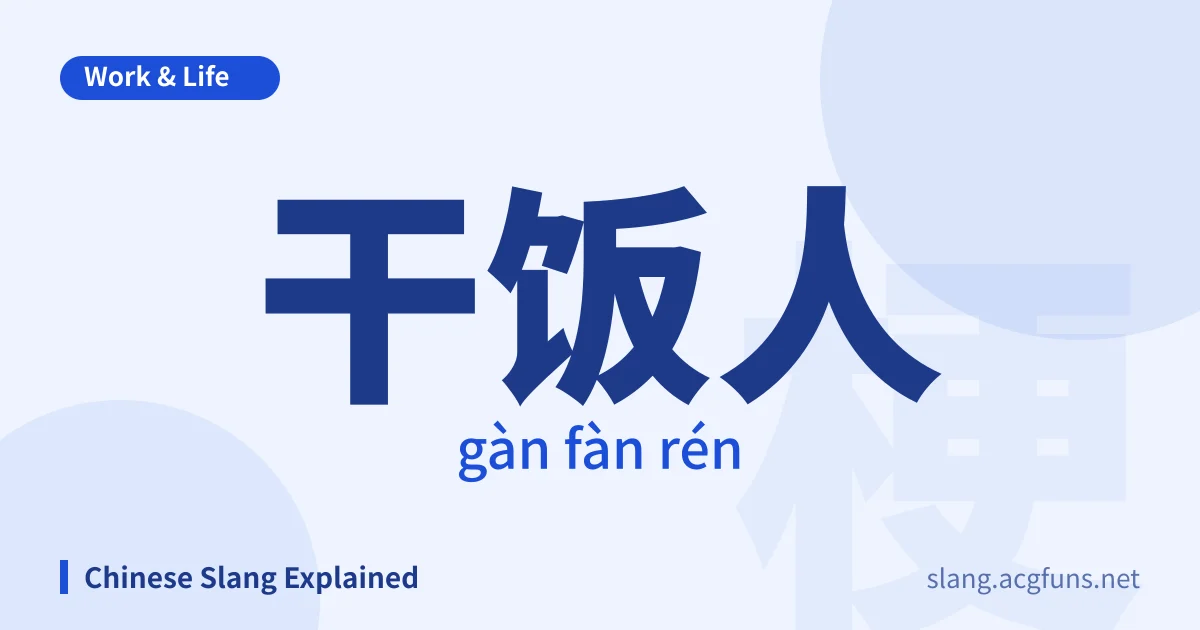
What does 干饭人 mean?
干饭 is a southwestern dialect way of saying to eat, with an emphasis on enthusiasm, and a 干饭人 is someone who treats every meal as the main event. The label took off on Douyin in November of 2020, powered by the chant 干饭人,干饭魂,干饭都是人上人, roughly that eaters stand above everyone. It arrived right after 打工人 and sits in the same self-mocking family: instead of moaning about work, it celebrates the one reliable joy in a workday, the meal. The hour before lunch doubles as prime 摸鱼 time, and the lunch debate is its star event.
Where does 干饭人 come from?
The word 干饭 comes from southwestern Mandarin, where 干 means to eat heartily. The meme broke out in November 2020, when Douyin users posted clips of themselves heading to meals with the chant 干饭人,干饭魂,干饭都是人上人. 搜狐 covered the trend on 17 November 2020 and 新京报 in mid-December, presenting it as the food-focused counterpart of the year's 打工人 jokes. Who first recorded the slogan is unclear; it spread through short-video remixes rather than a single source.
How to use 干饭人
- 下班铃一响,他抓起饭盒就往外冲:干饭人,干饭魂!
Xiàbān líng yī xiǎng, tā zhuā qǐ fànhé jiù wǎng wài chōng: gànfàn rén, gànfàn hún!
The second the end-of-day bell rang, he grabbed his lunch box and bolted for the door: a rice-devourer lives by the meal. - 午饭还没到十一点,群里已经开始讨论吃什么了,典型的干饭人时刻。
Wǔfàn hái méi dào shíyī diǎn, qún lǐ yǐjīng kāishǐ tǎolùn chī shénme le, diǎnxíng de gànfàn rén shíkè.
It wasn't even eleven yet and the group chat was already debating lunch, a classic rice-devourer moment.
Also available in: 日本語 · 한국어 · Español
Comments
Have you run into this word in the wild? Share where you saw it, who said it, and what happened.