雪山救狐
- Literally
- rescuing a fox on the snowy mountain
- Meaning
- The AI short film exchange “have you ever saved a fox on the snowy mountain”, “I am not the fox, I am that braised duck”, and the revenge-parody wave it opened in 2026
- Popular since
- 2026
What does 雪山救狐 mean?
Chinese ghost stories promise repayment: a scholar spares a fox and the fox comes back in human shape to serve him. A short AI film from February 2026 flipped that promise into a bill. A traveller leaves food for a fox in the snow, and months later somebody knocks to settle accounts, declaring that he is not the fox but that braised duck, 酱板鸭. The two lines now work as a passphrase, and the duck's slot is open to anything: commenters have answered as 豆汁, as a bacterium, as a nuclear bomb. The reversal is what makes the format reusable, and cheap video tools let anyone shoot the next episode overnight. Police accounts used the script for fraud warnings, and the joke still runs through the 抽象 corners of the internet.
Where does 雪山救狐 come from?
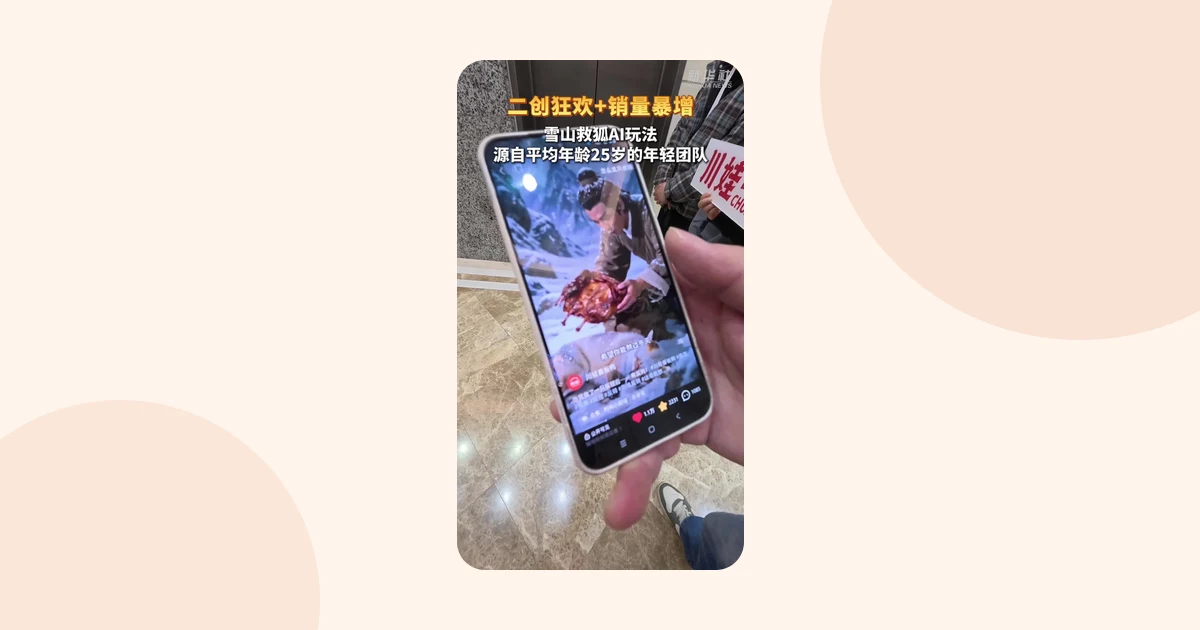
The first episode came from a four-person team in Guiyang with an average age around twenty-five, made in about five hours for some forty yuan to sell their region's braised duck, as 大河报 and a Xinhua video feature reported in early April 2026. The images copy the look of Shaw Brothers martial arts pictures. 浙江宣传 ran a comment piece in late March 2026, and by 27 March the topic had passed five billion views with roughly 150,000 news items logged. Once the wave reached Taiwan, the state council's Taiwan affairs office took questions about it on 8 April 2026.
How to use 雪山救狐
- 她帮同事改了方案,第二天桌上多了一张狐狸表情包:你可曾在雪山救过一只狐狸。
Tā bāng tóngshì gǎi le fāng'àn, dì èr tiān zhuō shàng duō le yì zhāng húli biǎoqíng: nǐ kě céng zài xuěshān jiù guo yì zhī húli.
She fixed a coworker's deck, and the next morning a fox sticker waited on her desk: have you ever saved a fox on the snowy mountain? - 反诈民警也套用这个句式拍视频,说自己不是狐狸,是你转错账户的那笔钱。
Fǎnzhà mínjǐng yě tào yòng zhège jùshì pāi shìpín, shuō zìjǐ bú shì húli, shì nǐ zhuǎn cuò zhànghù de nà bǐ qián.
Anti-fraud police borrowed the pattern too, announcing that they were not the fox but the transfer that went to the wrong account.
Also available in: Português · Italiano · Bahasa Indonesia · 简体中文 · 日本語 · 한국어 · Español · Français · Deutsch
Related slang
- 吃了不烧心chī le bù shāo xīn
catchphrase of honest street vendors from mass-produced AI dramas, now an all-purpose seal of approval that nothing cheated you
- 咕咕嘎嘎gū gū gā gā
Baby babble written in four characters, used as a membership signal and a way to switch thinking off, always next to a round penguin
- 抽象chōu xiàng
Absurd or surreal; 搞抽象 means making deliberately random, nonsensical humor.
Comments
Have you run into this word in the wild? Share where you saw it, who said it, and what happened.