厉娜体
- Literally
- the Lina ending
- Meaning
- Ending any ordinary sentence with the name 厉娜, a copycat format that spread in November 2026
- Popular since
- 2026
What does 厉娜体 mean?
Type whatever you were going to type, then close it with a name: 我不想上班了,厉娜. That is 厉娜体. The two characters are not punctuation, but millions of people now use them as if they were, a call to a person placed after the sentence is already finished, which turns a line of self-talk into something said to someone. The comedy is a mismatch of weight. The original delivery is grief, and the payload is dumplings, overtime or a coffee spilled on a keyboard, so the smaller the news the funnier the ending. 中华网 observed on 6 November 2026 that both syllables carry the fourth tone and drop hard when spoken, which is why other names sound loose in the same slot. Knowing the show is not required to join in, and that is the reason the format ran past its source. A comment that got passed around put it plainly: the ending gives every piece of nonsense and every small feeling a receiver.
Where does 厉娜体 come from?
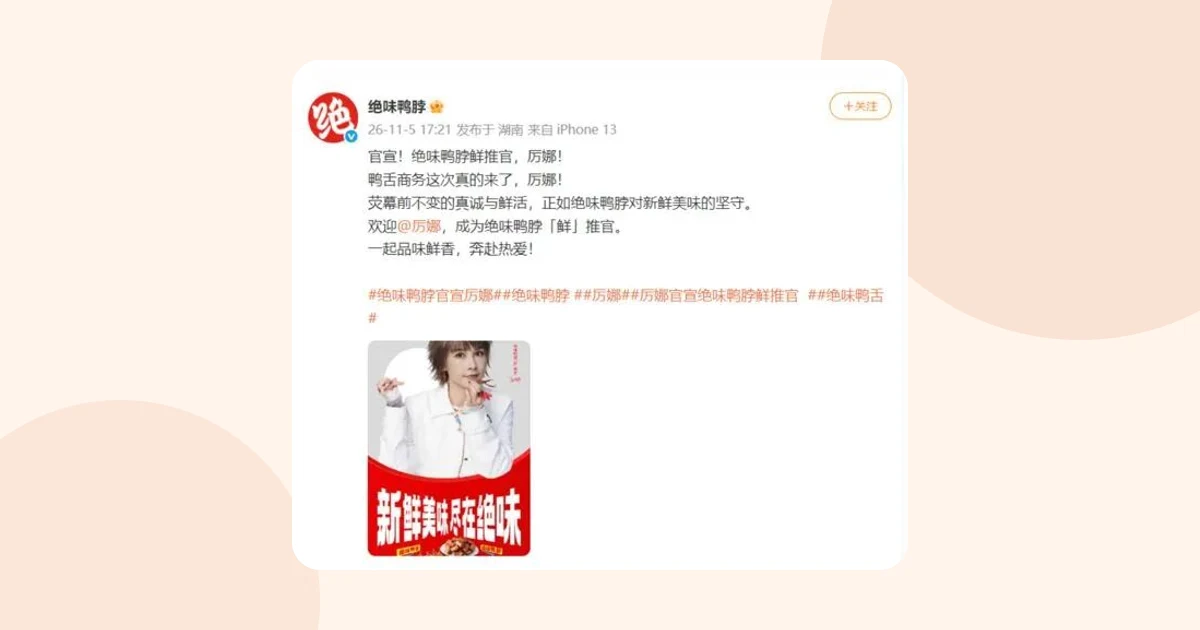
The material comes from 后会友期, a 芒果TV documentary-style variety show that started on 22 October 2026 and travels old friends who have stopped speaking. In a cabin on a cliff edge 许飞, one of the 2006 Super Girl cohort, keeps finishing her sentences with the name of the woman across the table, 厉娜, and two clips became the template: 我等这一刻等了十五年了,厉娜 and 我画地为牢啊,厉娜. The second line is filed on this site as 画地为牢. Comment sections cut the pattern out of the scene and named it, and 快懂百科 now lists 厉娜体 with the format given as 陈述句,厉娜. 芒果TV put the name at the end of its own program copy, and 中国新闻周刊 recorded that move on 6 November 2026 under the trending phrase 芒果TV把厉娜当句号使, in the same article that counted 5.7 billion plays on the show's main Douyin topic. 新京报 ran a quick commentary the same week arguing that a proper name had lost its referent and gained a job.
How to use 厉娜体
- 我妈在家庭群里发“今天饺子煮破了三个,厉娜”,我爸隔了半分钟回一句“谁欠你的,厉娜”。
Wǒ mā zài jiātíng qún lǐ fā “jīntiān jiǎozi zhǔ pò le sān gè, lì nà”, wǒ bà gé le bàn fēnzhōng huí yī jù “shéi qiàn nǐ de, lì nà”.
My mother posted 今天饺子煮破了三个,厉娜 in the family group and half a minute later my father answered 谁欠你的,厉娜. - 面试官问我上一份工作为什么离职,我憋住没把“排班把我画地为牢了,厉娜”说出口。
Miànshìguān wèn wǒ shàng yī fèn gōngzuò wèi shénme lízhí, wǒ biē zhù méi bǎ “páibān bǎ wǒ huà dì wéi láo le, lì nà” shuō chūkǒu.
The interviewer asked why I left my last job and I stopped myself from saying 排班把我画地为牢了,厉娜 out loud.
Also available in: 简体中文 · 日本語 · 한국어 · Español · Français · Deutsch · Português · Italiano · Bahasa Indonesia
Related slang
- 画地为牢huà dì wéi láo
A schoolbook idiom about self-imposed confinement, revived in October 2026 as the line 我画地为牢,厉娜 and as the template 我 plus idiom plus name
- 综艺删人学zōng yì shān rén xué
The fake academic label for clearing the whole cast from Weibo the day a show wraps, and for the argument about boundaries that came with it
Comments
Have you run into this word in the wild? Share where you saw it, who said it, and what happened.